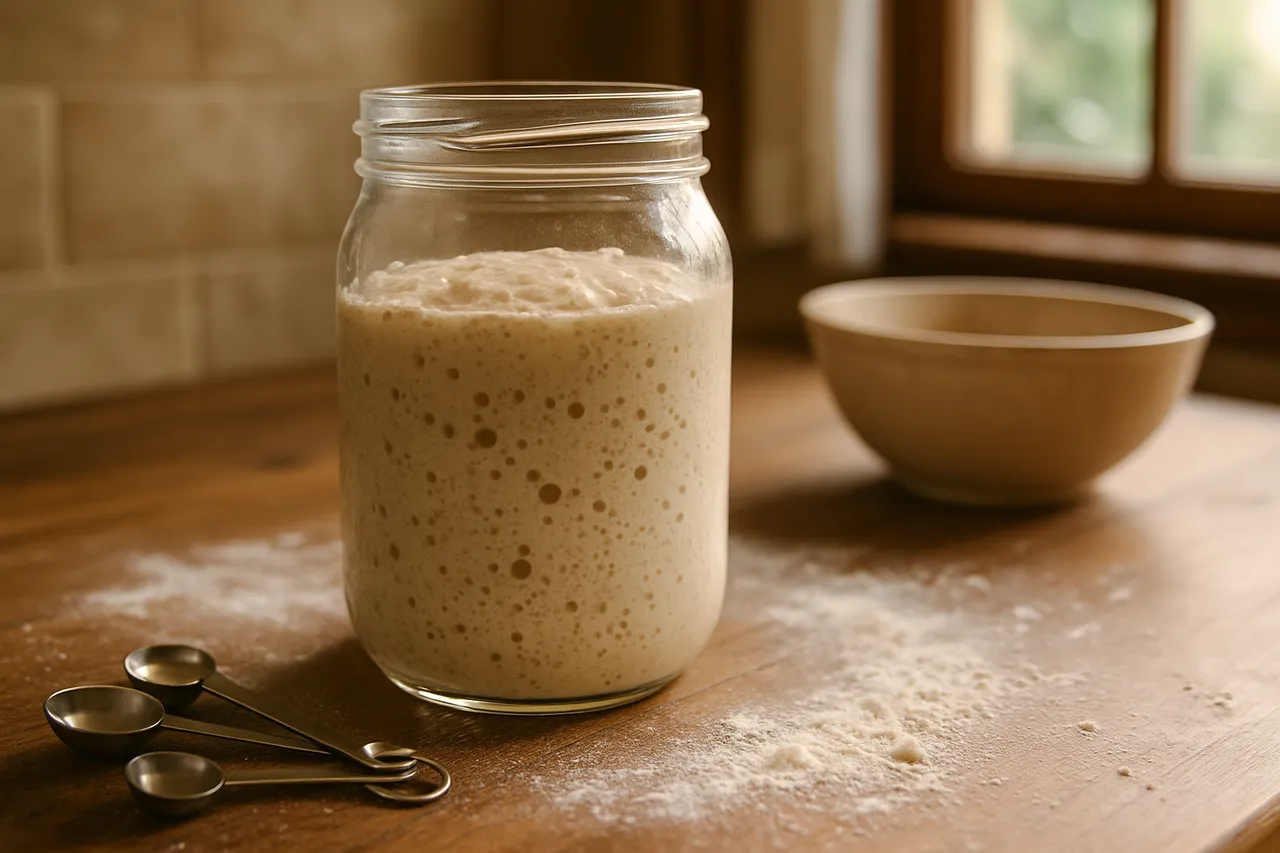
Sourdough Bread Basics
Sourdough is flour and water that's been sitting out. That's it. If you've wanted to try it but figured you needed a bunch of gear and a food-science degree, you don't.
Over six Monday evenings we'll build a starter from scratch, feed it, and figure out why it does what it does up here where the air is dry and things move fast. Then we mix, fold, shape, and bake an actual loaf.
We weigh things in this class, cups lie. Bring a notebook if you like writing things down, I do. Expect to get your hands in the dough, that's the whole point.
You'll leave with your own starter and bread you made yourself. - J
What you'll learn
- Mix and maintain a sourdough starter from scratch
- Read starter activity using rise, bubbles, and smell
- Test dough readiness with the float test and timing cues
- Shape a boule and score it for a clean bake
- Bake in a Dutch oven safely using steam
Materials & tools
What to bring
- Digital kitchen scale that reads grams (0-2000 g range, 1 g increments) — $12-25. This class weighs everything, so it's the one non-negotiable.
- Two clean wide-mouth glass jars, quart size, with loose-fitting lids — $8-12 for a set. One for your starter, one for feedings.
- A small notebook and pen for logging feed times, temperatures, and dough behavior — $2-5.
- Bread flour, one 5 lb bag (~12-13% protein, King Arthur or similar) — $4-6.
- A little whole wheat or rye flour (2-3 cups) to kick-start a livelier culture — $3-5.
- Fine sea salt or plain kosher salt, non-iodized — $3-5.
- Flexible bowl scraper or bench scraper — $6-10. Makes handling wet dough far less messy.
- Large mixing bowl, at least 4 quarts — $8-15.
Nice to have
- Dutch oven with lid, 4-6 quart (enameled or bare cast iron) — $40-80. Traps steam for a crackly crust.
- Round proofing basket (banneton), 8-9 in, with a liner — $12-18.
- Bread lame or a fresh double-edged razor blade for scoring — $8-12.
- Instant-read thermometer for water and dough temperature — $10-20. Helpful for controlling fermentation in dry, warm air.
Lessons
- It's just flour, water, and a scale
Why sourdough is simpler than it sounds and the one cheap tool you actually need.
- Mixing and feeding your first starter
Get a starter going in a jar, find it a home, and settle into a small feeding routine.
- Reading the jar day to day
Learn to judge rise, bubbles, and smell so you know what your starter is telling you.
- Getting the starter ready to bake
Float tests, water temperature, and peak timing that decide whether your starter is bake-ready.
- Mixing the dough and the bulk rise
From the first mix through autolyse, stretch-and-folds, and knowing when bulk fermentation is done.
- Proofing in dry canyon air
Handle skinning, overproofing, and the cold fridge proof that this climate demands.
- Shaping, baking, and cooling
Shape a boule, score it, bake it in a Dutch oven, and wait before you cut.
Key terms
- Sourdough starter
- A living culture of flour and water colonized by wild yeast and bacteria that leavens bread naturally, without commercial yeast.
- Levain
- A portion of active starter, often refreshed just before baking, that you mix into the final dough to make it rise.
- Discard
- The part of the starter you remove before each feeding to keep it from growing endlessly; it can be saved for pancakes, crackers, and other recipes.
- Hydration
- The ratio of water to flour in a dough or starter, expressed as a percentage, which controls how wet, sticky, and open the final loaf is.
- Autolyse
- A short rest of flour and water mixed together before adding salt and starter, which lets the flour hydrate and makes the dough easier to work.
- Bulk fermentation
- The first long rise, when the whole batch of dough ferments and develops flavor and strength before it is shaped.
- Stretch and fold
- A gentle technique of lifting and folding the dough over itself during bulk fermentation to build gluten strength without kneading.
- Proof
- The final rise of the shaped loaf before baking, when the dough relaxes and puffs; over-proofing leaves it slack, under-proofing leaves it dense.
- Oven spring
- The rapid rise a loaf gets in the first minutes of baking as trapped gases expand and the crust sets.
- Crumb
- The interior texture of the baked bread, described by how open, even, or tight the holes are.
Class discussion
- Pinned ·Welcome, and let's talk startersJulie Minor · Instructor · 8 replies
- Pinned ·welcome! class starts May 4Julie Minor · Instructor · 6 replies
- sourdough class wrap up 🙌Bailey Hansen · 3 replies
- Forgot the salt againJefferson Saenz · 2 replies
- hydration percentage question from the last classDanny Taylor · 2 replies
- Bring your notebook MondayJulie Minor · Instructor · 5 replies
More cooking & baking classes
Artisan Pizza Dough and Toppings
with William
Beyond Weeknight Italian: Sauces, Braises, and Fresh Pasta
with Devin
Bulgogi & Beyond: Korean Home Cooking
with Caroline