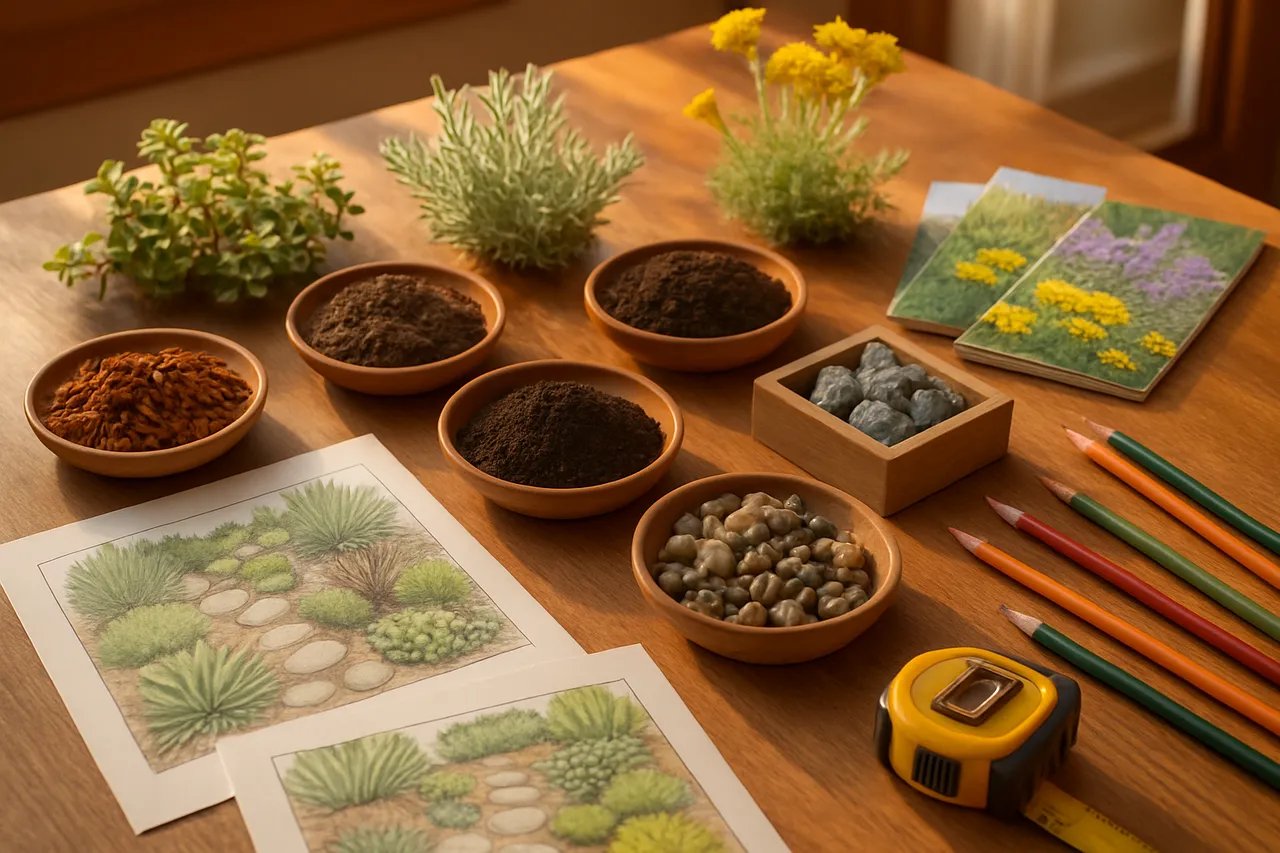
Xeriscaping for Utah Yards
Sooo here's the deal. If you're tired of watching a water bill climb every August for a lawn that still looks embarrassed in the heat, this class is for you. We'll walk through designing a low-water yard using plants that belong here, the ones that live through our dry summers and hard water without you babying them. This is hands-on. I'll bring plants, actual soil, a bag of mulch, and you'll get your hands in it. We'll cover picking plants that live, watering deep and rare, mulch (the thing everybody skips), and planting in fall instead of spring. You'll leave able to rip out a section of thirsty lawn and put in something that looks right in August. And no, I'm not going to let you gravel the whole thing 👍
What you'll learn
- Assess your yard's sun, shade, and soil
- Group plants by water needs and drainage
- Plant correctly using fall timing and proper spacing
- Set up basic drip irrigation and mulch beds
- Choose healthy plants and avoid landscape fabric mistakes
Materials & tools
What to bring
- Garden gloves, snug leather or coated-nitrile — $8-15
- Hand trowel, stainless steel — $6-12
- Transplanting/hori-hori knife or a narrow perennial spade for tight root holes — $15-30 (a sturdy hand trowel can substitute)
- Bypass hand pruners for trimming roots and plants — $12-25
- Kneeling pad or foam knee cushion (planting is on-the-ground work) — $8-15
- Tape measure, 25 ft, for measuring beds and park strips — $8-15
- Graph paper or a printed grid pad plus a pencil, to sketch your own yard plan to scale — $5-8
- Refillable water bottle, sun hat, and sunscreen (classes run outdoors in full Utah sun)
Nice to have
- Round-point shovel or garden spade for removing sod and digging larger holes — $20-40
- 5-gallon bucket for hauling mulch, weeds, and amended soil — $4-6
- Soil moisture probe or screwdriver, to check how deep water actually soaks in — $0-20
- Bag of coarse wood-chip or bark mulch to practice a 3-4 inch layer at home — $4-6 per cubic foot
- Small notebook for plant names, spacing, and watering schedules
Instructor typically provides demonstration plants, soil, and mulch for in-class work; bring your own tools so they fit your hands.
Lessons
- Rethinking Your Yard
What xeriscaping actually means, what your August water bill really costs, and where a lawn still belongs.
- Reading Your Site
Walking your yard section by section to read its sun, soil, water, and elevation before planting anything.
- Choosing Plants That Don't Quit
A short list of tough plants and the native-versus-adapted question without fussing over Latin names.
- Buying Plants Smart
Why small one-gallon pots and a healthy root ball beat the showy stuff at the nursery.
- Laying Out the Beds
Spacing plants for growth, grouping them by thirst, and borrowing a natural look with rock and structure.
- Watering and Mulch
Watering deep and rare, learning to leave plants alone, and mulching as the cheapest thing you can do.
- Drip Irrigation and Ground Cover
Setting up drip irrigation and why landscape fabric under gravel is a trap.
- Getting Plants in the Ground
Planting in fall instead of spring and working through the whole planting process start to finish.
- The First Year and Beyond
Surviving the sulky first year of native plants and taking the yard one small task at a time.
Key terms
- Xeriscape
- A landscape designed to thrive on very little supplemental water by using drought-tolerant plants, efficient irrigation, mulch, and smart design.
- Water-wise (waterwise) plant
- A plant that survives and looks good on minimal watering once established, and is suited to Utah's dry, cold-winter climate.
- Hydrozone
- A group of plants with similar water needs planted together so one irrigation zone can water them all correctly without over- or under-watering.
- Establishment period
- The first one to two growing seasons after planting, when even drought-tolerant plants need regular water to grow deep roots before you cut back.
- Deep and infrequent watering
- Watering longer but less often so moisture soaks well below the surface, encouraging deep roots instead of shallow, thirsty ones.
- Mulch
- A surface layer of wood chips, bark, or gravel spread over soil to hold in moisture, block weeds, and moderate soil temperature.
- Park strip
- The narrow band of ground between the sidewalk and the street, often the hottest, driest part of a yard and a prime spot to replace lawn with water-wise plants.
- Drip irrigation
- A system of tubing and emitters that delivers water slowly right at the plant's roots, cutting the evaporation and runoff of overhead sprinklers.
- Soil amendment
- Material like compost worked into native soil to improve its structure, drainage, and ability to hold water and nutrients.
- Native plant
- A species that grows naturally in the local region and is already adapted to its soil, rainfall, and temperature swings.
Class discussion
- Pinned ·Welcome — and what's actually growing (or dying) in your yard right nowScott Sorensen · Instructor · 12 replies
- Pinned ·Welcome to Xeriscaping for Utah Yards - class starts May 5Scott Sorensen · Instructor · 7 replies
- pulled out half my front strip and didn't even feel guiltyAlexa Brown · 1 replies
- actually mapped my drainage like she saidBrenden Johnson · 1 replies
- Fall planting — why I'm having you do this now instead of AprilScott Sorensen · Instructor · 1 replies
- Last one — send me a photo of your one small thing this weekScott Sorensen · Instructor · 1 replies
More home & garden classes
Basic Home Repair for New Homeowners
with Bryan
Cold Frames & Row Covers: Growing Past the Frost
with Debbie
Drought Tolerant Plant Selection
with Diane