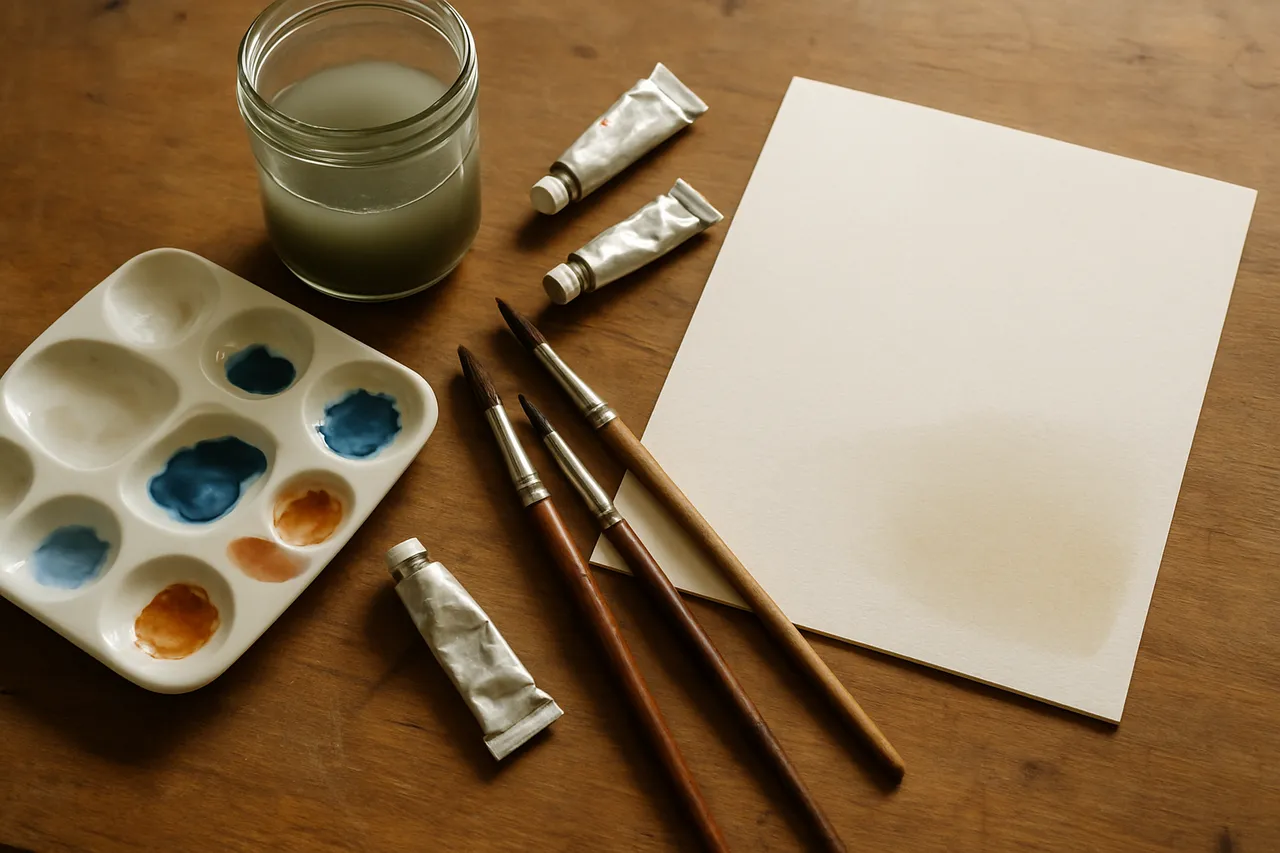
Beginner Watercolor Painting
This is a relaxed start for adults who have never picked up a brush. We work small, layer fast, and let the dry Utah County air do half the drying for us. Most online tutorials assume humid weather and lie to you about timing, so we teach to the air we actually have.
You'll practice basic washes, learn how colors mix (and what makes mud, so you can make it on purpose), and build up to simple foothill and mountain landscapes. Cheap paper, six colors, a round brush and a flat one. That's the whole kit.
No critiques, no pressure to finish anything or take it home framed. You'll leave able to lay a clean wash, mix the colors you actually see, and paint a small landscape you don't hate. Heck yes.
What you'll learn
- Choose and stretch the right watercolor paper
- Paint flat and graded washes with control
- Mix greens, grays, and browns without mud
- Layer glazes and manage wet edges deliberately
- Build a landscape from sky to foreground
Materials & tools
What to bring
- Watercolor paper, cold-press, student-grade, 140 lb (300 gsm), 9x12 pad — cold-press has enough tooth to hold a wash; skip printer paper, it buckles and pills. $8-14
- A small set of tube or pan watercolors with at least these six: a warm and cool of each primary (e.g. yellow ochre or lemon yellow, a red, and a blue like ultramarine and one green-blue) — a basic student set covers this. $10-20
- One round brush, size 8 or 10 — the workhorse for washes and detail. $5-12
- One flat brush, 3/4 inch — for broad, even washes and skies. $5-10
- Two water containers (one to rinse, one for clean water) — old jars or yogurt tubs work fine. Free
- A ceramic plate, plastic palette, or old white saucer for mixing. $0-8
- Pencil (HB) and a soft (kneaded) eraser for light sketching. $3-6
- Paper towels or a cotton rag for lifting paint and controlling water. Free-$3
- Painter's tape or a board to keep paper flat while it dries. $4-7
Nice to have
- A spray/mister bottle to keep paint and paper workable in dry air. $2-5
- A separate small round brush (size 2-4) for fine detail. $4-8
- A gray-scale or color-mixing chart card for reference. $3-6
Lessons
- Supplies and losing your fear of the paper
The minimal kit, why paper weight matters, taping down, and deliberately ruining a page so the blank sheet stops intimidating you.
- The three washes and reading your water
Flat, graded, and wet-on-wet washes, plus learning to judge exactly how wet your brush really is.
- Mixing color without making mud
Warm and cool versions of your colors, believable greens, what turns a mix muddy, and the local gray-brown of the foothills.
- Layering, glazing, and texture
The dry-between-layers rhythm, glazing to deepen color, controlling soft versus hard edges, and cheap texture tricks like salt and lifting.
- Painting a full landscape
Applying everything to a real scene: sky and clouds, distant mountains, composition and sketching a plan, foreground detail, and knowing when to stop.
- A plain sky wash from a reference photo20 min
- Clouds by lifting, not by painting18 min
- Making the far mountains sit far away22 min
- Where to put stuff (I work by feel, honestly)16 min
- Sketching a loose plan from a photo18 min
- Sky, mountains, foreground, in that order25 min
- Dry grass, scrub, and a few marks for interest22 min
- Knowing when to stop, or not finishing at all15 min
Key terms
- Wash
- A thin, even layer of diluted watercolor spread over an area, forming the basic building block of most watercolor paintings.
- Wet-on-wet
- Applying paint onto paper that is already damp, so colors spread and blend softly with fuzzy edges.
- Wet-on-dry
- Applying paint onto dry paper, which produces crisper, more controlled edges and shapes.
- Cold-press paper
- Watercolor paper with a lightly textured (toothed) surface that grips pigment well and is the most forgiving choice for beginners.
- Pigment load
- How much paint versus water is in your mix, which controls whether a color goes on pale and transparent or deep and saturated.
- Granulation
- The grainy, mottled texture some pigments leave as heavier particles settle into the paper's texture.
- Lifting
- Removing or lightening paint from the paper with a clean damp brush, tissue, or rag while it is still wet.
- Value
- The lightness or darkness of a color, which in watercolor is controlled mainly by how much water you add rather than white paint.
- Mud
- The dull, muddy brown-gray that results from overmixing too many colors or layering opaque or complementary pigments carelessly.
- Blooms (backruns)
- Cauliflower-shaped watermarks that form when wetter paint flows back into a drying area, sometimes a flaw and sometimes used on purpose.
Class discussion
- Pinned ·Welcome! Class starts May 5 — say hi before thenElizabeth Smith · Instructor · 11 replies
- got a layer to actually dry before it bledMathew Romney · 7 replies
- salt technique on the last nightMathew Romney · 3 replies
- tuesdays are gonna feel weird without this class lolMelanie Beeson · 1 replies
- Where'd everyone get their watercolor paper for class?Ian · 0 replies
- Layering going muddy on meMelanie Beeson · 0 replies
More arts & crafts classes
Beginner Crochet
with Marilyn
Free-Motion Quilting: Finish a Lap Quilt on Your Home Machine
with Morgan
Hand Quilting Fundamentals
with Morgan