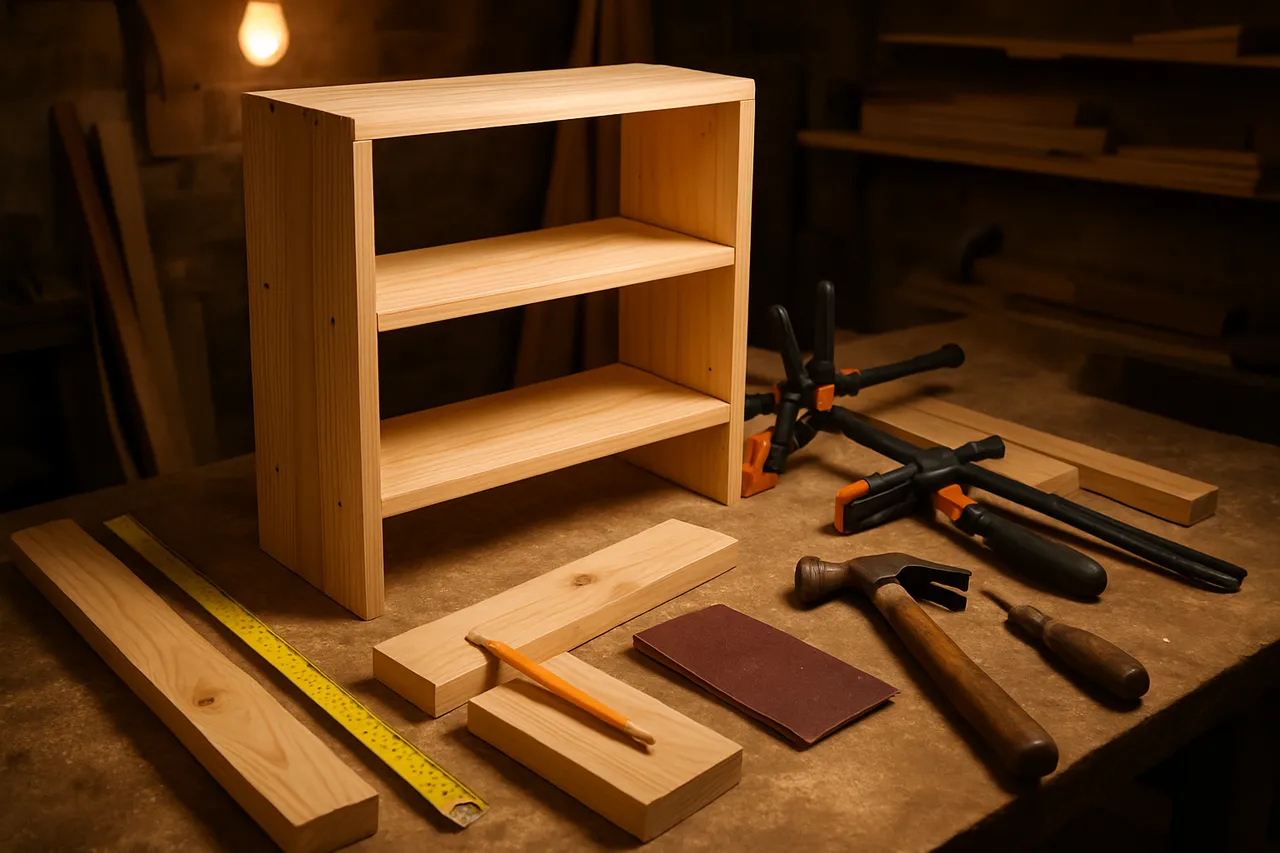
Intro to Woodworking: Build a Small Shelf
This class is for anyone who has never touched a table saw and wants to leave with something they built with their own hands. Over six Monday evenings we'll build one small wall shelf, start to finish. You'll measure, mark, cut, sand, and assemble, and I'll walk you through the tools so they stop being scary.
We start with hand tools before we touch anything with a motor, because I feel like you learn more when you can feel a cut go wrong. We'll use pine, which is cheap and forgiving, so it doesn't matter if you ruin a board.
You'll leave with a shelf you understand, and can build again on your own. Not great, but it held. That's usually how it starts.
What you'll learn
- Measure and mark boards from one reference edge
- Make straight cuts with a hand saw and table saw
- Drill pilot holes and drive screws without splitting wood
- Assemble, clamp, and check joints for square
- Sand through grits and hang the finished shelf level
Materials & tools
What to bring
- Safety glasses (ANSI Z87.1 rated) — $6-15. Required before any cutting or sanding.
- Tape measure, 16 ft with a 3/4" blade — $8-15. A locking blade and clear markings help.
- Combination square, 12" — $12-25. Used to mark square cut lines and check assembly for square.
- Carpenter's pencil or a couple of sharp #2 pencils — $2-5.
- Pine board stock (1x6 or 1x8 common/whitewood board, roughly 3-4 ft) — $8-18. Confirm whether the instructor supplies this before buying.
- Wood glue, 8 oz PVA (Titebond II or Original) — $5-8.
- Sandpaper assortment, grits 120 / 150 / 220 — $8-12. A few sheets of each.
- Handsaw for hand-cut practice: a Japanese pull saw (dozuki/ryoba) or a fine crosscut panel saw — $15-35.
Nice to have
- Two small clamps (4"-6" spring or bar/F-style) — $8-20 each. Holds glue-ups and steadies stock for cutting.
- Sanding block or foam sanding sponge — $4-8. Keeps sanding flat and saves your fingers.
- Wood finish for the final shelf: small can of wipe-on polyurethane or Danish oil, plus a rag — $10-15.
- Work gloves for handling rough lumber (remove them before running any powered tool) — $6-12.
- Countersink bit or a set of wood screws (#8, 1-1/4") if screwing the shelf together — $6-12.
Lessons
- Getting Started and Buying Your Wood
What the shelf is and getting your pine home before class.
- Measuring and Marking Before You Cut
Reading the wood and laying out lines you can actually follow.
- Cutting Your Pieces to Size
Hand saw, table saw, and the drill until every piece is cut.
- Setting up a hand saw cut20 min
- Feeling the saw bind, and what that teaches you22 min
- Checking your cut against the square15 min
- The table saw safety talk, straight25 min
- Your first cuts on the table saw22 min
- The drill, pilot holes, and not splitting your board20 min
- Cutting all your shelf pieces to size25 min
- Dry-Fitting and Marking the Joints
Laying out the parts and clamping without glue to check the fit.
- Gluing and Assembling the Shelf
Gluing, fastening, and clamping it square overnight.
- Sanding, Finishing, and Hanging It
Sanding, the finishing hand-off, and getting it level on the wall.
Key terms
- Grain
- The direction of the wood fibers in a board, which affects how it cuts, sands, and takes finish, and which can splinter if worked against.
- Nominal vs. actual dimension
- The difference between a board's stated size and its real size — a 1x8 pine board is actually about 3/4 inch thick and 7-1/4 inches wide after milling.
- Kerf
- The narrow slot of material a saw blade removes as it cuts, which you must account for when marking so your finished piece ends up the right length.
- Crosscut
- A cut made across the grain of the board, typically to bring a piece to length.
- Rip cut
- A cut made along the length of the board, parallel to the grain, usually to reduce its width.
- Butt joint
- The simplest joint, where the end of one board is placed flat against the face or edge of another and fastened with glue, screws, or nails.
- Pilot hole
- A small hole drilled before driving a screw, which guides the screw and keeps the wood from splitting.
- Countersink
- A cone-shaped recess drilled at the top of a pilot hole so a screw head can sit flush with or below the wood surface.
- Square
- A 90-degree relationship between two edges or faces; a project is 'out of square' when its corners are not true right angles.
- Grit
- The coarseness rating of sandpaper — lower numbers (like 80-120) remove material fast, higher numbers (180-220) smooth the surface for finishing.
Class discussion
- Pinned ·Welcome to Intro to Woodworking - class starts May 4Andy Petersen · Instructor · 14 replies
- cut my shelf board a whole inch short lolJuan J. · 0 replies
- clamps for dry fit tonight, how many is enoughTaylor Torres · 0 replies
More home skills & diy classes

Basic Car Maintenance for Utah Winters
with Mark

Bike Tune-Up Basics
with Ryan
Build a Side Table: Dowel and Pocket-Hole Joinery
with Andy